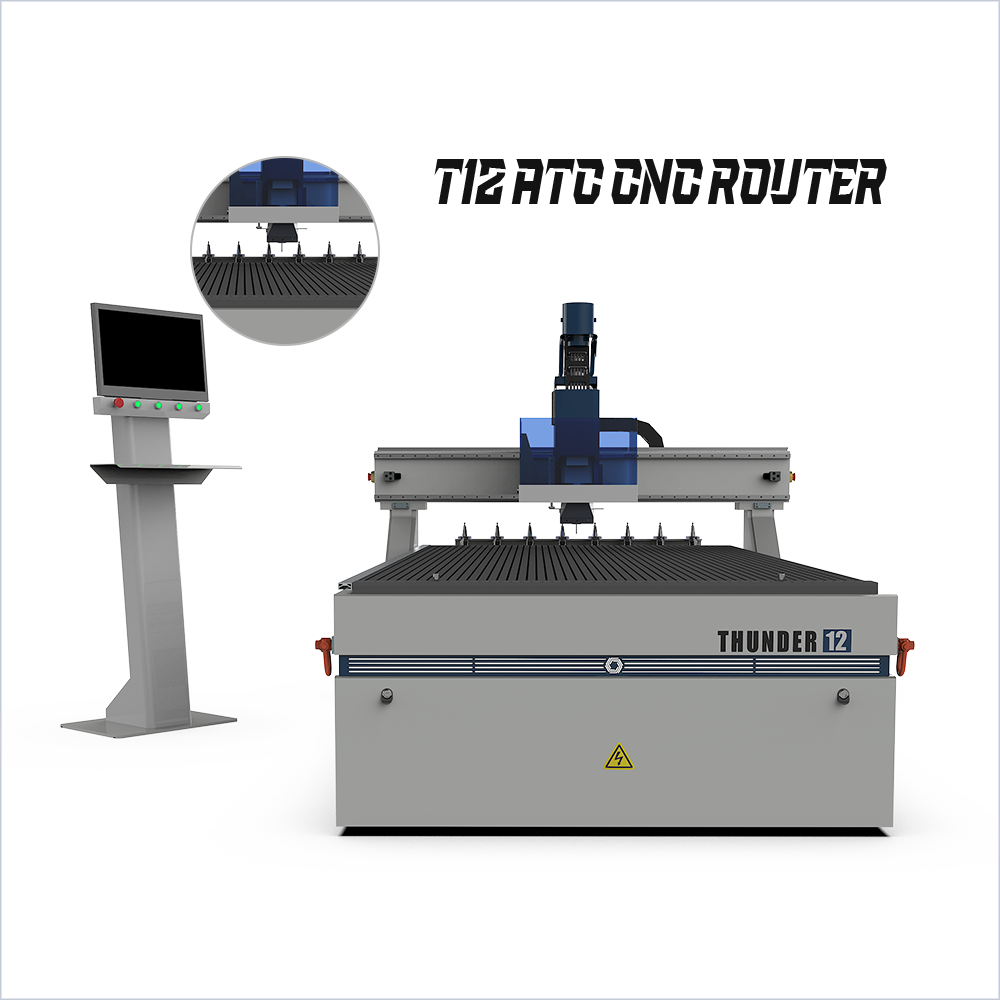
For production environments handling high-variance materials—from dense hardwoods to EPS foam and casting molds—manual tool changes and recalibrations are the primary bottleneck for spindle uptime. Operators lose countless hours manually swapping bits. They constantly reset zero points. This downtime severely cripples output capacity when running complex multi-stage jobs. Scaling from standard 3-axis equipment to a high-capacity automatic tool changer requires profound mechanical upgrades. It demands far more than merely bolting a tool rack onto an existing frame. True scaling demands industrial-grade chassis rigidity. You need precise Z-axis calibration. You must implement material-specific tooling strategies. Standard hobby-grade frames vibrate excessively under heavy loads. They lose critical tolerance during rapid multi-tool operations. This guide breaks down the structural requirements, tooling configurations, and implementation realities of a T12 ATC CNC Router. We provide a rigorous technical evaluation framework. You can use this to determine if this advanced setup aligns with your production efficiency goals.
Key Takeaways
Capacity Meets Variance: A 12-slot linear or carousel ATC configuration provides enough dedicated tooling to seamlessly transition between roughing, detailed V-bit carving, and edge profiling without operator intervention.
Industrial Architecture: True high-yield foam and mold processing requires specialized features—such as movable rotary axes and V-block fixture integration—not just an enlarged standard woodworking chassis.
Critical Calibration: Spindle lifespan and precision rely heavily on automatic tool setting calibration, robust control systems (like LNC or Syntec), and adequate vacuum hold-down systems.
Why the T12 ATC Architecture is the Standard for Mixed-Material Production
Many production shops attempt to process dense foams and casting molds using standard routers. They quickly discover severe structural limitations. An Industrial ATC CNC Router Machine requires a distinct mechanical baseline. You cannot simply attach an automatic tool changer to a lightweight gantry. A true industrial chassis utilizes heavy-duty welded steel tubing. It undergoes stress-relieving heat treatments. Manufacturers must equip the machine using 30mm linear guide rails. These heavy rails handle extreme dynamic loads during high-speed routing. Standard hobbyist models typically use 20mm rails. These lighter rails flex under aggressive feed rates. This flexion destroys your dimensional accuracy. Processing molds requires absolute rigidity to prevent chatter marks on the final surface.
We must examine the mechanics of the tool change itself. Production facilities typically choose between a linear tool magazine and a carousel system. Both systems utilize ISO30 or BT30 tool holders.
Linear Tool Magazine: The gantry physically moves to the back of the worktable. It retrieves tools from a stationary rack. This method is highly reliable. It features fewer moving parts.
Manipulator/Carousel: A robotic arm handles the tool selection. It performs a rapid grab-pull-rotate-insert-return sequence. This mechanism operates alongside the gantry. You achieve much faster tool changes.
A 12-tool capacity represents the optimal engineering sweet spot. It perfectly balances maximum machining utility against minimal gantry weight. Adding a 24-tool rack creates excessive mass. You force the servo motors to pull unnecessary weight. A T12 setup provides ample slots for varied operations. You avoid bloated travel times across the work area.
Spindle power remains equally critical. You need high-frequency spindles to process varied densities. A standard 9KW spindle easily maintains torque across different materials. It powers through hard maple effortlessly. It also carves delicate EPS foam without bogging down. Operators must adjust the spindle RPM carefully. Transitioning between dense wood and soft foam demands strict speed regulation. High power ensures the bit never stalls inside deep material cuts.
Tooling Setup Strategies: Woodworking vs. Foam vs. Molds
Different materials demand highly specific tooling strategies. You cannot use the same end mill for plywood and aluminum. We detail the ideal T12 configurations for three distinct production applications below.
Configuration for Woodworking & Furniture Making
Operating a CNC Router for Furniture Making requires strategic tool allocation. You must fill your 12 slots wisely. We recommend assigning compression bits for clean plywood cuts. Compression geometry pushes chips toward the center of the board. This prevents top and bottom veneer tear-out. You should reserve one slot for a heavy surfacing bit. This handles slab flattening rapidly. V-groove bits handle decorative cabinet doors. You should also integrate a dedicated drill bank. A drill bank operates independently of the main spindle. It drills shelf pin holes instantly.
Hold-down logistics dictate your overall production speed. Panel furniture manufacturing relies entirely on powerful vacuum beds. You need at least a 7.5KW vacuum pump. Larger tables require dual 7.5KW pumps. We strongly advise using pneumatic pop-up pins. These pins provide rapid, repeatable sheet alignment. Operators slide the fresh board against the raised pins. They engage the vacuum pump. The pins drop automatically. Cutting begins immediately. This eliminates manual edge finding.
Configuration for EPS Foam & 3D Sculpting
Foam carving requires massive Z-axis clearance. You must allocate slots for extended-reach ball nose end mills. These tools handle deep 3D sculpting. They feature long flute lengths. You also need specialized foam roughing bits. They clear bulk material exceptionally fast. Foam melts easily if friction builds up. You must program high feed rates. You must keep the spindle RPM relatively low. This creates large chips rather than fine dust.
Workpiece positioning presents a notorious pain point. Foam blanks and electrodes often suffer from manual alignment errors. You can solve this using V-block auxiliary clamps. Operators secure these clamps directly into the T-slot table. The T-slots run between the vacuum zones. This mechanical fixture eliminates tedious manual measuring. It ensures perfect zero-point repeatability across multiple carving batches.
Configuration for Resin, Aluminum, and Casting Molds
Mold making introduces harder, heat-sensitive materials. You must integrate single-flute aluminum cutting bits into your magazine. Single-flute designs provide superior chip evacuation. Fine engraving tools handle intricate mold lettering. You mount these delicate tools in precision ER32 collets.
Cooling becomes an absolute necessity here. Processing wood substitutes, resins, and light metals generates intense friction. You mandate automated mist cooling systems. Industry professionals call this Minimum Quantity Lubrication (MQL). It sprays a fine mist of oil and air directly onto the cutting edge. Strict feed-rate override controls are essential. If you push an end mill too fast through aluminum, it snaps instantly. Controller macros must regulate these parameters.
Material Application |
Primary Tool Types Needed |
Hold-Down Mechanism |
Cooling Requirement |
Panel Furniture (Plywood/MDF) |
Compression bits, V-groove, 5mm drills |
High-CFM Vacuum Bed + Pop-up Pins |
Air / Dust Extraction only |
EPS Foam & 3D Props |
Extended ball nose, Foam roughing bits |
T-slot Clamps + V-blocks |
Air / Low RPM settings |
Aluminum & Resin Molds |
Single-flute O-flute, Fine engravers |
Mechanical Clamping |
MQL Mist Cooling System |
Evaluating a 4 Axis CNC Router Engraving Machine ATC
Adding rotary capabilities unlocks entirely new product lines. A 4 Axis CNC Router engraving Machine ATC handles complex 3D geometries effortlessly. The 4th axis operates smoothly alongside a standard T12 setup. You can process cylindrical molding. You can carve ornate table legs. You can sculpt large 3D foam props. The machine rotates the workpiece continuously while the spindle cuts. This reaches undercuts impossible on a flatbed.
Space optimization remains a vital consideration. Standard fixed rotary axes consume valuable table space. A permanently mounted rotary unit restricts your flatbed capacity. You should look for movable rotary designs. Operators can push the rotary unit to the table's extreme end when idle. Some designs mount the rotary entirely off the side of the machine frame. This clever engineering frees up the front end completely. You retain full, unhindered access for standard 3-axis flatbed operations.
Software dependencies dictate your ultimate success. You must assess your CAM software requirements carefully. Simple index routing only rotates the piece between flat cuts. It is basically positional 3+1 machining. True 4-axis simultaneous toolpath generation moves the X, Y, Z, and A axes together. You need powerful software to drive simultaneous continuous motion. Programs like Powermill or Mastercam generate these complex toolpaths. They create perfectly smooth organic shapes without visible stepping marks.
Calibration, Precision, and Control Systems
Precision relies entirely on intelligent machine calibration. Manual touch-off is dangerously obsolete in an Automatic Tool Change CNC Router. Relying on paper or metal shims to find Z-zero introduces human error. It wastes valuable production time.
Automated tool setting gauges prevent catastrophic Z-axis plunge errors. They drastically reduce your scrap rates. Here is exactly how the automatic calibration process works:
The spindle completes a successful mechanical tool change.
It moves directly to a fixed sensor pad mounted on the machine frame.
The new bit lowers slowly until it triggers the highly sensitive pad.
The controller instantly reads the trigger signal and calculates the exact tool length offset.
The spindle returns to the workpiece maintaining perfect Z-axis zero across all 12 tools.
Choosing the right "brain" matters immensely. The controller dictates how smoothly the machine operates. You must evaluate industry-standard controllers carefully. We commonly see Taiwan LNC and Syntec systems in production environments.
Taiwan LNC offers independent keyboard operation. It handles ATC macros with excellent reliability. The interface remains relatively intuitive. The learning curve is moderate for new operators. Syntec provides an incredibly advanced environment. It is widely used in heavy industrial applications. Syntec excels at complex 4-axis simultaneous operations. It executes multi-axis look-ahead algorithms perfectly. This prevents jerky spindle movements during complex 3D carving.
Implementation Realities and Facility Requirements
Transitioning to a high-end Woodworking CNC Machine demands proper preparation. You face a distinct learning curve. Operators require significant upskilling. They must master advanced CAM software programming. They need to thoroughly understand toolpath optimization. You cannot simply press "start" and walk away. Operators must learn how to configure nested layouts. They must monitor tool wear life.
Maintenance assumptions must be clear from day one. You need a rigorous daily maintenance schedule. Neglect leads directly to mechanical failure. We recommend these strict maintenance practices:
Lubricate the 30mm linear guide rails weekly. Dry rails destroy the ball bearing blocks.
Clean the automatic tool rack constantly. This prevents dust buildup inside the tool holder tapers.
Check pneumatic pressure daily. Low pressure causes the drawbar to fail during a tool release.
Inspect collets for interior wear and replace them every few months.
Facility requirements often surprise new equipment buyers. You must upgrade your workshop infrastructure. The machine demands stable 3-phase power availability. Single-phase adapters will not suffice for a massive 9KW spindle. The starting amperage draw is immense. Compressed air quality is equally crucial. You must supply dry, highly filtered air to the machine. Moisture in the air lines will rapidly destroy the ATC spindle release mechanism. Rust inside the drawbar ruins the entire spindle. High-CFM dust collection systems are absolutely mandatory. Foam and MDF generate extreme volumes of fine particulate. You need at least a 5HP dust collector. You must run smooth-wall ducting directly to the spindle shroud.
Conclusion
Shortlisting Logic: A T12 setup is absolute overkill for simple 2D panel cutting. However, it becomes essential for complex operations. If you process 3D molds, thick foam props, or intricate furniture, you genuinely need this capacity. Jobs requiring four or more distinct tools per sheet demand an automated solution.
Next Steps for Buyers: We highly recommend requesting a physical test cut. Send your most difficult material to the manufacturer. Ask them to cut deep foam or thick hardwood. You must verify the exact tool-change cycle time in person. Confirm the calibration repeatability before signing any purchase order.
Operational Readiness: Ensure your facility meets all electrical and pneumatic requirements before delivery. Pre-train your operators on the specific CAM software. This guarantees immediate production capability upon installation.
FAQ
Q: Can a single T12 ATC machine seamlessly switch between cutting hardwood and EPS foam?
A: Yes, provided the operator updates the spindle RPM, feed rates in the controller, and ensures the dust collection/cooling systems are adjusted for the specific material.
Q: How does automatic tool setting calibration actually work?
A: After a tool change, the spindle moves to a fixed sensor pad. The bit lowers until it triggers the pad, instantly updating the controller with the exact tool length to maintain Z-axis zero across all 12 tools.
Q: Does an ATC CNC router completely replace manual finishing in furniture and mold making?
A: No. While 5-axis or advanced 4-axis machines reduce 90% of roughing and detailing, micro-finishing, sanding, and specific hand-carved textures often still require traditional craftsmanship. The CNC is a capacity multiplier, not a total human replacement.


