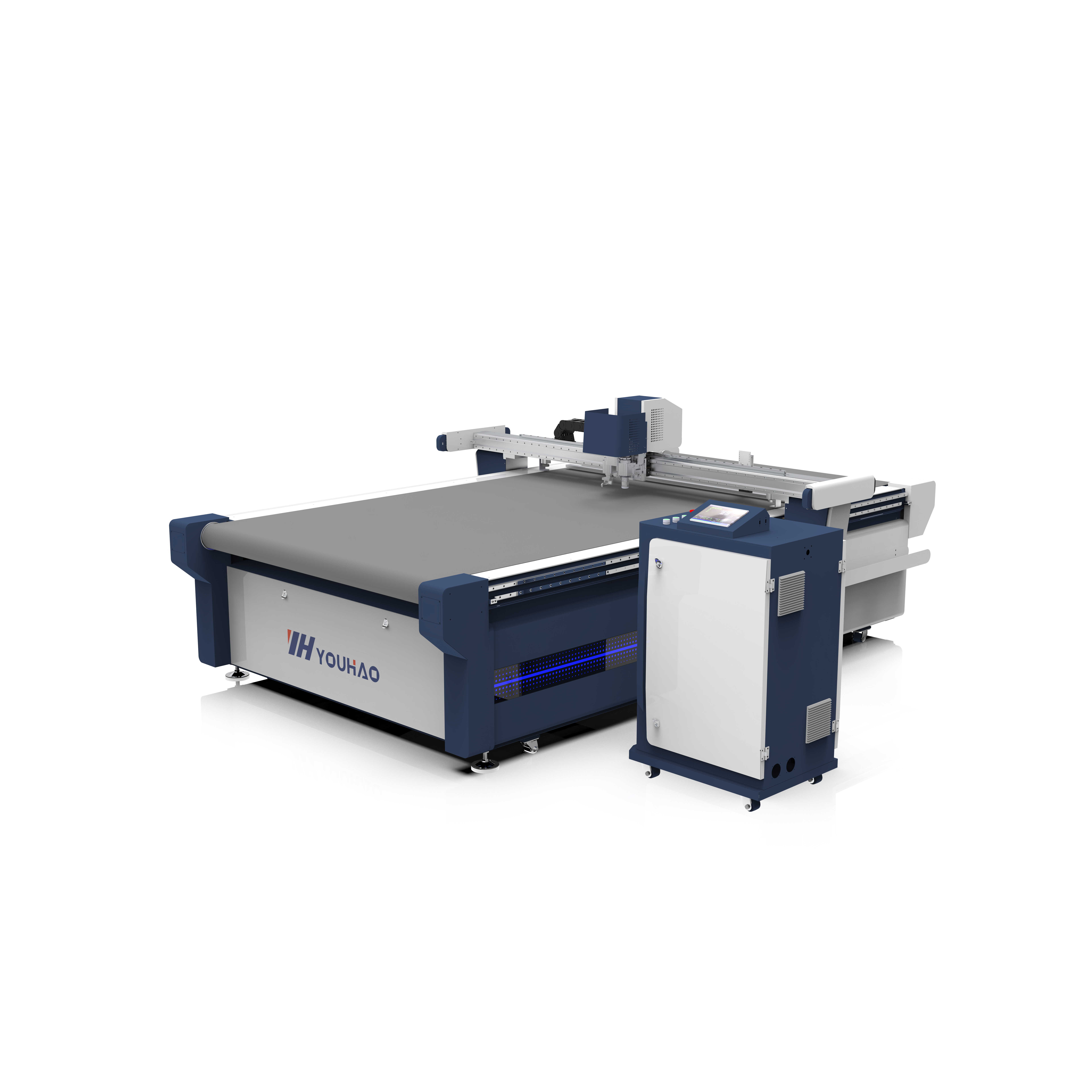
Mid-to-high-volume manufacturing often hits a critical bottleneck. Scaling flexible material processing without sacrificing edge quality or introducing thermal distortion remains difficult. Facility managers constantly struggle to balance speed with precision. You likely face this challenge when relying on outdated methods. Transitioning from manual cutting, rigid die-cutting, or thermal lasers to automated cold-cutting solves this underlying issue. These traditional methods simply cannot keep pace with modern agile production demands.
We will explore how advanced engineering addresses these batch constraints directly. You will learn how the synchronous and asynchronous dual-head architecture actively transforms your facility's daily output. Furthermore, we will break down the spatial and operational realities of implementing this technology. By the end, you will understand exactly how the C9 Dual-Head Oscillating Knife Cutter fundamentally reshapes material yield, slashes cycle times, and modernizes your entire factory workflow.
Key Takeaways
Throughput Multiplication: Dual-head configuration functionally doubles output for identical nested patterns without doubling the floor space.
Material Yield: Algorithmic nesting combined with precise cold-cutting increases raw material utilization from typical manual baselines (75-80%) to upwards of 90%.
Operational Transition: Moving to digital cutting eliminates die-tooling costs and lead times, though it requires shifting operator skill sets toward CAD/CAM software.
Facility Requirements: Successful implementation requires factoring in footprint not just for the machine, but for the automated feeding and offloading buffer zones.
The Engineering Problem: Why Traditional Cutting Fails at Batch Scale
Thermal cutting tools often ruin synthetic flexible materials. Lasers burn the edges of woven fabrics and melt nylon components. They also release hazardous volatile organic compounds (VOCs) into your factory air. Such environmental and quality issues require expensive extraction systems and secondary edge-cleaning processes. Manufacturers need a strictly non-thermal alternative for sensitive composites. Cold-cutting eliminates heat damage entirely, ensuring perfect edge integrity.
Die-cutting presents another massive barrier to agile production. You must evaluate the hidden burdens of traditional press cutting. Physical molds require significant upfront investments. Lead times for new dies delay product launches by weeks. Storing thousands of heavy metal dies consumes valuable warehouse space. Furthermore, you lose the ability to perform agile, on-the-fly prototyping. If a client requests a dimension change, you must discard the old die and buy a new one.
When production volumes surge, single-head CNC solutions quickly become throughput bottlenecks. A single cutting head can only travel so fast before mechanical inertia causes inaccuracies. You cannot simply turn up the speed without tearing the fabric or snapping the blade. Therefore, scaling up necessitates a completely different mechanical approach. Upgrading to a dual-head architecture splits the workload mechanically. This solves the batch production challenge by running parallel cutting paths simultaneously.
![C9 Dual-Head Oscillating Knife Cutter]()
The dual-head system operates using sophisticated dynamic modes. Synchronous cutting allows both heads to execute identical patterns on two halves of the table simultaneously. This functionally halves the cycle time for uniform batch orders. Conversely, asynchronous distribution allows each head to tackle different geometries within the same nest. The control software actively balances the workload between the two gantries. This dynamic distribution drastically increases overall daily throughput.
High-frequency kinematics dictate the precision of these machines. The cutting blades reciprocate rapidly, executing between 12,000 and 20,000 vibrations per minute. This ultra-fast vertical motion creates a distinct shearing action. It acts much like an electric carving knife, slicing cleanly through fibers rather than dragging them. Dragging causes material tearing and frayed edges. High-frequency oscillation prevents this damage completely, ensuring clean cuts on highly elastic textiles.
A major strength of this architecture lies in its interchangeable tool matrix. You can easily swap tools to process entirely different substrates.
Electric Oscillating Tools (EOT): These use high-wattage electric motors. They work best for medium-density composites, corrugated cardboard, and felt.
Pneumatic Oscillating Tools (POT): These harness compressed air. They generate immense downward force, making them ideal for heavy rubber and rigid sealing gaskets.
Specialty V-Cut and Long-Stroke Tools: When utilized as a Foam Board Cutting Machine, operators equip specialized long-stroke blades. These tools slice through thick, high-density foams and packaging materials without compressing the core.
Workflow Automation: Continuous Production Integration
Modern batch manufacturing relies heavily on automated material handling. The conveyor system mechanically drives this continuous workflow. An Automatic feeding table vibrating knife setup continuously pulls rolled materials onto the cutting bed. A crucial element here is tension-controlled unwinding. If a feeding mechanism yanks the fabric, it stretches before cutting. Once cut, the fabric relaxes and shrinks, ruining your dimensional accuracy. Tension control feeds the material gently, preventing distortion entirely.
Securing the material during high-speed cutting requires a zoned vacuum system. Many buyers hold a common industry misconception regarding material hold-down. They assume effective hold-down relies entirely on raw vacuum pump horsepower. This is false. A massive 11kw pump wastes energy if the table cannot isolate the suction. True efficiency relies on dynamic zoned coverage. The software automatically opens vacuum valves only under the specific areas where the material sits. This matches the material's porosity and locks it firmly against the felt underlay.
Software ecosystems bridge the gap between initial design and immediate execution. You import CAD files directly into the nesting software. The algorithms rotate and interlock the pieces to minimize waste. Flaw-recognition capabilities take this a step further. Overhead cameras scan the material for defects, and the software automatically rearranges the cutting paths to avoid them. This creates a seamless, uninterrupted bridge from digital design to final product.
Analyzing ROI and Operational Economics
Material yield optimization drastically improves your bottom line. Realistic benchmarks show a stark contrast between old and new methods. Traditional manual or die-cut material usage typically hovers around 75% to 80% utilization. Human operators simply cannot calculate complex geometric nesting in their heads. Software-optimized nesting fits parts together tightly, mimicking a jigsaw puzzle. This increases raw material utilization to upwards of 90%. You effectively reduce physical material waste by 10% to 15%.
Application-specific efficiencies create unique operational savings. Consider a facility cutting genuine animal hides. When utilized as a commercial Leather Fabric Cutting Machine, visual recognition technology shines. The system scans the hide, identifies scars, and projects the nesting layout onto the table. This eliminates tedious manual flaw avoidance. The operator skips the lengthy physical inspection process entirely. Conversely, when cutting rigid gaskets, the machine saves money by rapidly executing tight internal radii without expensive punch tools.
Tooling cost elimination provides immediate financial relief. You completely bypass third-party die-makers. You no longer pay hundreds of dollars per custom mold. Furthermore, you drastically reduce your time-to-market for new product iterations. If a client needs a design tweak, your engineer updates the CAD file in five minutes. The machine cuts the new prototype instantly.
You must also plan for ongoing consumables and standard maintenance. Transparency regarding these expectations ensures smooth operations.
Consumable / Component | Expected Lifespan | Maintenance Action Required |
Tungsten Steel Blades | 40 - 120 cutting hours | Replace upon visible edge dulling to prevent material tearing. |
Conveyor Felt Underlay | 6 - 12 months | Adjust penetration depth to minimize scoring. Replace when porous. |
Linear Guide Rails | Lifelong (with care) | Apply specialized grease weekly to maintain smooth head travel. |
Vacuum Pump Filters | 3 - 6 months | Clean out fabric dust monthly. Replace filter element periodically. |
Implementation Realities and Rollout Risks (E-E-A-T Focus)
Facilities must strictly evaluate true spatial requirements before delivery. Footprint constraints often derail implementation projects. The machine bed represents only one part of the overall equation. Rear material staging for heavy rolls demands an extra two to three meters of clearance. Front offloading and sorting areas are equally critical for uninterrupted batch flow. You must design buffer zones around the machine. Without adequate space, your operators will face constant material handling bottlenecks.
Operators face a noticeable training curve during this transition. Acknowledge the shift from mechanical labor to digital oversight. Factory workers can no longer rely solely on physical craftsmanship. They must be actively trained in three critical areas:
CAD File Preparation: Understanding layers, line colors, and vector formats.
Nesting Software Navigation: Setting up parameters for optimal yield.
Machine Calibration: Adjusting blade pressure and vacuum zones.
Finally, your facility must survive a material-specific internal ramp-up period. Out-of-the-box settings rarely work perfectly for proprietary composites. You must build your own calibration database. Operators need time to test various feed rates, oscillation speeds, and vacuum settings tailored to your specific materials. Documenting these parameters ensures consistent quality across different shifts and reduces operator guesswork.
Shortlisting Criteria: Evaluating the Right CNC Oscillating Knife Cutting Machine
Choosing the correct CNC oscillating knife cutting machine requires analyzing your true production metrics. First, define your specific volume thresholds. A single-head machine works perfectly for bespoke prototyping or low-volume runs. However, once you process multiple rolls per day, single heads bottleneck the factory. Transitioning to a Dual-Head Oscillating Cutter makes economic sense when your daily yield requirements double without the ability to expand your facility footprint.
Budgeting realities must align with your capability expectations. A realistic framework separates machines by grade. Budget models rely on stepper motors and basic software. Mid-tier servo-driven machines offer much higher precision and longer lifespans. Industrial continuous-production centers include heavy-duty welded beds, vision systems, and automated conveyors. Understand which tier matches your durability needs.
Here is a simplified chart to help frame your evaluation between single and dual setups:
Criteria | Single-Head System | Dual-Head Architecture (C9) |
Best Fit For | Prototyping & Low-Volume Production | High-Volume Batch Production |
Cycle Time Impact | Baseline speed | Cuts cycle time by up to 50% for symmetric nests |
Space Efficiency | Standard footprint | Maximized output per square meter |
Recommend concrete evaluation steps before signing a purchase order. Request a formal time-study on a specific, complex DXF file. Ask the manufacturer to run it and record the cycle time. Furthermore, send proprietary material samples directly to the factory for test cuts. These physical proofs validate edge quality far better than any brochure.
Conclusion
The C9 dual-head architecture serves as a comprehensive workflow upgrade, designed to safely remove the traditional die-cutting bottleneck.
Algorithmic nesting drastically reduces material waste, ensuring much higher yields per roll.
Eliminating physical dies allows for rapid prototyping and true agile manufacturing.
Facilities must proactively plan for proper machine footprint, operator software training, and custom calibration databases.
We strongly encourage production engineers to schedule a technical consultation, request a custom material yield calculation, or submit sample fabrics for a proof-of-concept test cut today.
FAQ
Q: What is the realistic cutting tolerance of the C9 Dual-Head Oscillating Knife?
A: Real-world tolerances typically range from ±0.1 mm to ±0.5 mm. The final accuracy depends heavily on your material's elasticity, thickness, and how effectively the zoned vacuum system holds the substrate during high-speed cutting.
Q: Can the machine process both rolled fabrics and rigid boards simultaneously?
A: You cannot process them simultaneously, but changeovers are swift. To cut rigid boards, operators turn off the automated conveyor feeding, switch to static mode, and swap the cutting tool to an electric oscillating blade or milling tool suited for boards.
A: The control software universally accepts industry-standard vector formats. This includes DXF, PLT, AI, and PDF files exported from standard CAD or vector graphic software packages.
Q: How does the oscillating knife prevent fraying on synthetic textiles?
A: Unlike rotary drag blades that pull and stretch fibers, the oscillating knife uses high-frequency vertical physical shearing. This rapid up-and-down motion slices cleanly through textiles, completely maintaining cold-cut edge integrity without fraying or heat damage.